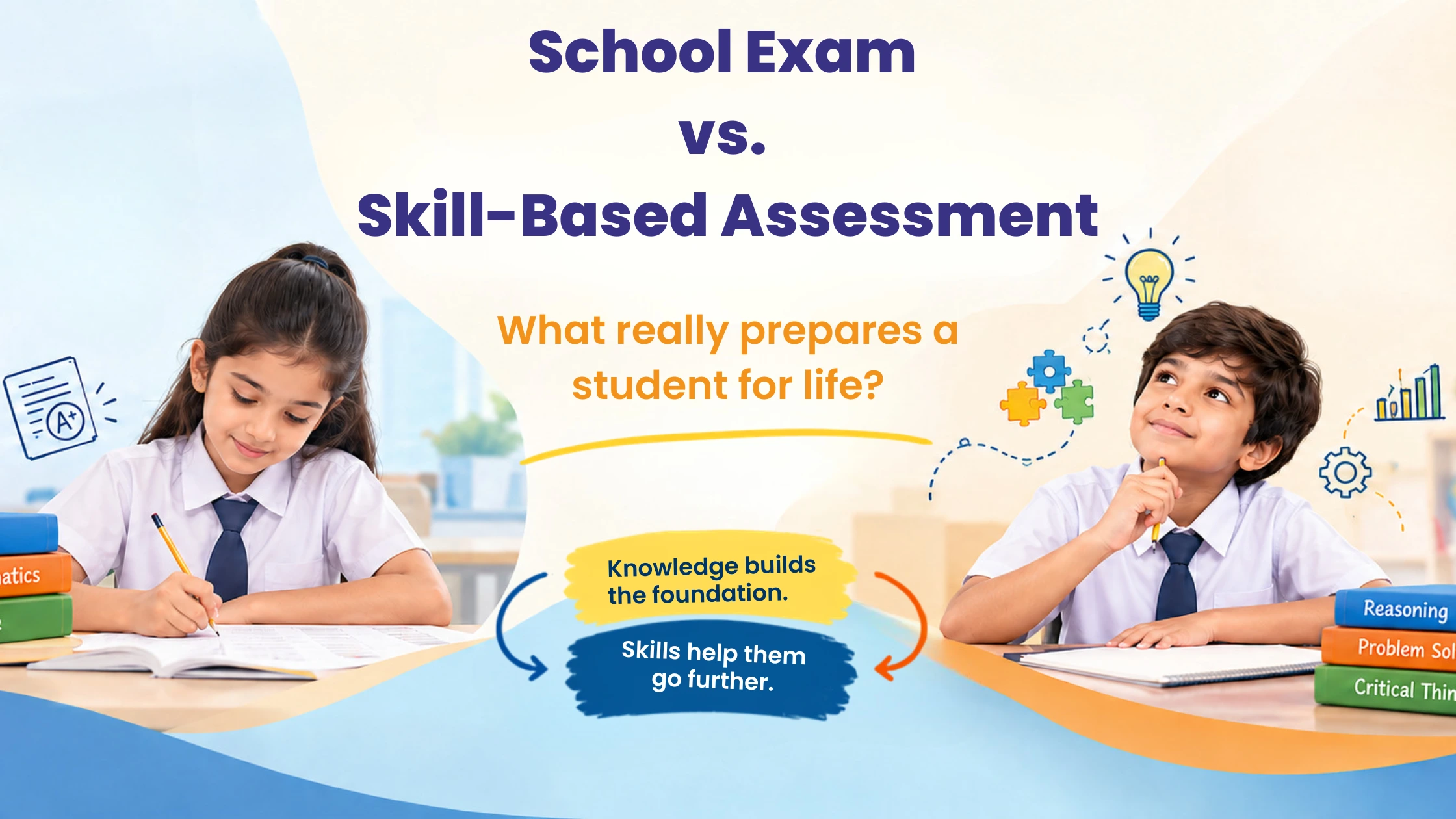
In our previous blog, we explored how school examinations and skill-based assessments measure different aspects of student learning. While the former focuses on how much students have learned, the latter looks at how they apply concepts. But competitions bring another aspect to learning. Let’s look at how they can benefit school students.
Skill-based competitions for school students give them an opportunity to apply their knowledge differently. They encourage students to think, apply concepts, solve problems, and even tackle new questions. Such competitions not only complement the learning that takes place within the classroom but also promote skill development activities for students.
Beyond Grades and the Syllabus

A student’s academic learning remains largely dependent on factors such as grades, marks, tests, assignments, and examinations. While these do serve the purpose of assessing a student’s understanding and knowledge, there are other methods that can help students strengthen their learning.
Skill-based competitions help students become more comfortable with new problems and questions. While a question may not be based directly on the concepts they have been taught, it may require them to apply a concept they are familiar with. Instead of following the usual way of approaching a problem, students may need to think differently and consider other possibilities.
This is how such competitions can help students develop new skills and strengthen their existing ones.
Enhancing Problem-Solving Skills

Problems are a part of our everyday lives, and so is problem-solving. They can arise at any age and in different situations. Students have to find solutions to problems whether they are at school, at home, or in other areas of their lives.
Most competitions for school students include questions that require them to go beyond simply recalling information. This helps them become more comfortable with challenging problems. Such competitions also help students learn how to deal with situations where they are unable to arrive at the right answer immediately.
They may have to attempt a problem, review their approach, and then try again. This is one of the important benefits of skill-based competitions, as students learn to move beyond their mistakes rather than focus only on their scores.
Developing Logical and Critical Thinking Skills

Students encounter enormous amounts of information every day. It is important for them to develop logical and critical thinking skills so that they can understand, process, and evaluate this information.
Many educational competitions for students include questions based on logical thinking and encourage students to use their analytical skills, understanding, and critical thinking to attempt them. These experiences can strengthen the habit of thinking before responding.
Applying Knowledge and Understanding

Students tend to retain information and concepts much better when they can apply them.
A concept they learn in Maths may appear in the form of a challenging question. A grammar rule they learn in English may appear in a passage that requires a different approach. Similarly, Science concepts can be presented through situations that require students to use their understanding of the subject.
This is another important benefit of skill-based competitions. They not only allow students to apply what they have learned but also help them use their understanding of different concepts.
Parents and teachers can also use these experiences to identify areas where students may need improvement. For instance, a student may understand a concept, but their ability to apply it may be weak. Another student may need more practice in developing their reasoning skills, while a third may need to work on their time management skills.
Confidence-Building Opportunities

Confidence-building is not about being the best at everything. It is more about the self-belief that develops when students try, learn, and gradually improve.
For students, skill-based competitions provide an opportunity to try, make mistakes, and, in the process, build self-confidence. They also give students exposure to challenging questions, time constraints, and the experience of attempting problems independently.
A student who lacks confidence and is often unsure while answering difficult questions may become more comfortable with similar questions when they are exposed to them regularly.
They may not always achieve a high rank, but they can develop a better understanding of the types of questions they may encounter and the mistakes they may make in the beginning. It is not always about grades or ranks, but also about building the right mindset and self-motivation to study and practise.
Broader Opportunities for Students

Every student has their own set of skills and strengths. While some students might be good at calculations, others might find it difficult to excel at language-related questions. Similarly, some might prefer solving logical and reasoning-based questions, while others may enjoy challenges based on Science and Maths.
Such educational competitions for students can give them an opportunity to identify their strengths and work on areas where they need improvement. These competitions improve students’ skills and also help them understand that learning is not limited to the syllabus.
There is value in exploring a topic, practising a skill and applying knowledge in a new situation. For schools, skill-based competitions can add to the learning opportunities available to students. For parents, they offer another way to encourage students to practise important skills without placing too much emphasis on grades and performance.
Learning From Success and Setbacks

Competitions have winners and participants who may not receive a rank or award. While winners may receive appreciation and recognition, other participants also have an opportunity to learn from the experience. Students should learn to appreciate their successes and understand their setbacks, as both experiences can help them improve.
A good rank can encourage a student to continue working on their strengths, while a lower rank can help them understand where they need to practise more. This is what makes competitions for school students valuable because they give students a reason to keep learning and improving.
Beyond Just Competitions for School Students
The goal of skill-based competitions for school students should not be limited to achieving a higher rank. These experiences can become a valuable part of a student’s larger academic journey and contribute to their academic profile as they move towards higher studies and, eventually, future professional roles where skills such as reasoning, problem-solving, and independent thinking are valued.

NELTAS Skill-Based Assessments — ECAT | M-CAT | S-CAT for Grades 2–8 — provide students with a structured platform to participate in subject-based assessments and competitions while getting experience beyond their regular school examinations.
Ultimately, the value of competitions for school students extends beyond the result. The skills, experiences, and achievements gained along the way can become a meaningful part of a student’s learning journey.